Welcome!

Welcome to my personal blog for retro video gaming, movie and television reviews as well as a lot of other junk from the 80's and 90's. Thanks for stopping by! When you're done reading check out my webpage to the right for my art and other projects.
Showing posts with label Game reviews. Show all posts

Wednesday, August 12, 2015

Retro Review: Valis the Fantasm Soldier (Sega Genesis)

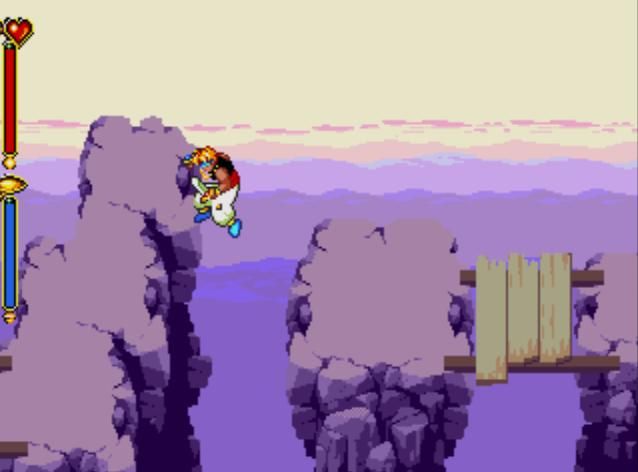
When monsters and gouls start running amok in the neighborhood, who you gonna call? In typical late 80's anime tradition, a timid highschool girl of course. Valis is the story of warring fantasy realms and the destiny of Yuko Ahso as she answers the call to become their savior, the Valis Warrior.

In the beginning, on what starts out as a typical rainy day at school, Yuko is assaulted by nightmarish monsters. A disembodied voice calls out to her, commanding her to open her eyes and take hold of the sword that has materialized in front of her. From here you take control of Yuko to lead her through the monster infested city streets and subway below.

Before the second stage begins you're treated to a rather lengthy cut scene where you meet the mysterious woman, Varia, who explains what the heck is going on. In a nut shell, a war lord by the name of Rogles has seized control of Vecanti, the Dream World, as well as the Fantasm Jewels and it's up to you to stop him before his power grows enough to over throw both Vecanti and the Human world.

The cut scenes in this game are really long, lasting close to fifteen minutes or so a piece. The artwork and animation are nice to behold, like scenes right out of a late 80's anime. Unfortunately the text scrolls painfully slow making them a chore to get through if you've already seen them before. There's a misconception that you cannot skip them but thankfully you can by pressing start a few times (kind of like a double click).

Gameplay wise, Valis is a 2D platformer that will likely remind you of the classic Castlevania series at first. Yuko moves a bit sluggishly though the controls respond well, but thankfully she has other options in maneuverability to make up for it. Along with a standard jump she can super jump by holding up when you jump. She can slide Mega Man style by pressing down and A, which oddly enough seems to be more useful for platforming than dodging enemy attacks. Her slide actually defies gravity when performed on a ledge, letting her travel the full length of the slide through the air before she drops which makes it especially useful for clearing small pits. The problem with using it for dodging seems to be with the hit detection. Her hit box seems much larger than it should be despite her laying on the ground during the slide. In some instances it almost seems to be as tall as her standing sprite. So in that regard, think of her slide as more of a dash than an evasion.

The slide in action

You begin the game with a standard sword slash as your attack but it can be upgraded to fire projectiles through various power ups. Each version of the sword can be powered up 3 times by collecting the same type of icon. My recommendation is to decide which one you like the best and stick with it. If you switch your power up by grabbing a different icon then your attack will return to level 1 with the new projectile so make sure it's one that you want.

In addition to the Valis sword's abilities Yuko is also granted a magic spell for every boss defeated, which is usually the bosses main attack a la Mega Man. Outside of unloading on the bosses they're pretty useless as your standard attacks are more than enough to dispatch the enemies in the stages.

By the end of the game you'll have a pretty big, albeit useless, arsenal


The stages are large, able to scroll in all directions, but the platforming itself is pretty basic. You won't find any kind of moving or disappearing platforms and falling in a pit usually results in you having to back track the stage a bit. Your biggest enemy is usually the scrolling itself. The screen doesn't move left or right until Yuko is a little over half way across the screen. More problematic is the upward scrolling which doesn't occur until she's nearly at the top of the screen. If you move too quickly you'll find yourself running right into an enemy or a projectile so often times you'll find yourself just throwing out random projectiles just for security as you move forward. You'll also do a lot of empty jumping just to force the screen to scroll upward to see the path ahead.

Aside from the cut scenes, Valis really shines in the music, background, and character designs. The game sports a lot of detail and parallax scrolling for depth. The majority of the sound track is really good except for maybe one track (the lava stage) which is is dull and repeats too often due to its length.

Valis is one of my all time favorite games, though mainly out of nostalgia. Players that enjoy that particular late 80's to early 90's anime charm will appreciate the art style and story more than others.

If you're looking for a challenging platformer you won't find it here as the game is pretty easy. I can really only recommend it if you're looking for a comfy gameplay experience. If you want my biased opinion though definitely check it out to get a start on a great series.

Pros:

-The game controls well and you'll get used to handling Yuko quickly.
-Beautiful artwork and character designs if you're into anime.
-Nice graphics and music for the most part.
-Lots of weapon options and a magic system.

Cons:

-Text scrolls extremely slow during cut scenes.
-Camera scrolling issues.
-Seasoned platformer fans might find it too easy.

Thanks for reading!

Monday, May 11, 2015

Sonic Boom Shattered Crystal Review

Since I've owned the full version of Sonic Boom Shattered Crystal for some time now, I wanted to expand my original review on the game. Much of it will be the same, just take the original as a demo review of a demo game.

And now the full review:

To address the first question on everyone's minds: Does it play like a traditional Sonic the Hedgehog game? Well kind of sort of, but it's a good thing. That is if you're open to change. The element of speed is there though capped and not momentum based. Keeping your speed up is reflective of your reaction time to the enemies and stage obstacles. Thankfully the controls are really responsive and I was able to adapt to the physics quickly. A few minutes in and I was able to flow through the stage at a constant speed, dispatching enemies and swinging over pits with ease.

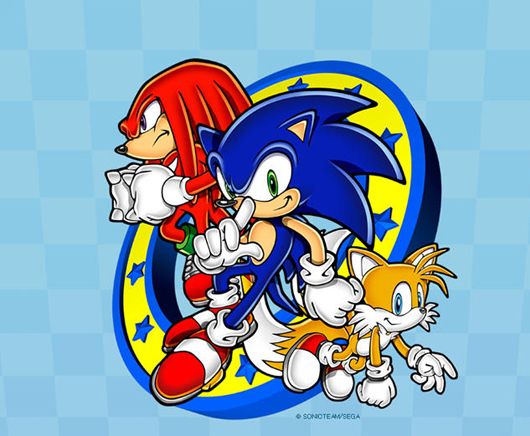
You have access to all four characters at the same time with the ability to switch to each on the fly. For the most part everyone moves and plays the same with the exception of Sonic being slightly faster. In addition each character has their own special abilities for attacking and gaining access to different paths. Sonic has an air dash that breaks certain kinds of walls, Tails can fly/glide, Knuckles can burrow, and Sticks has a boomerang that can be manually guided to hit switches that are out of reach.


The stages are massive with a multitude of branching paths and secret areas accessible by using each character's special abilities. The goal of each stage isn't so much about finding the exit but exploring to find all the hidden items and areas. It's almost like Sonic meets Metroidvania. The map on the bottom screen that you fill in as you progress further drives that feeling of exploration.

The game is divided up amongst several regions that have their own unique environments and map screens. Each map contains a stage or two as described above as well as a worm tunnel and racing stage. The worm tunnels are what I would consider the "special stage" of the game in that you only control Sonic from a 3rd person perspective as you speed down a tunnel collecting rings and dodging obstacles to complete certain challenges, such as grabbing all the rings or completing the tunnel under a certain time limit. The racing stages remind me of the Sonic Rivals series in that once again you control Sonic by himself and race against another character to complete a more speed oriented stage.

The main point of the extra themed stages and exploring of the main stages is to locate the scattered shards of the ancient crystal which you will need to complete in order to foil Lyric's ultimate plans. Shards are found laying around in the main stages while completing one of the extra stages will award you with one shard. The other challenges, such as beating a stage within a time limit or with a certain amount of rings awards you a token that you can use a QNC's shop to unlock character and enemy 3D models to look at. Or if you want to be lazy about it, you can gain one token every 24 hours by completing a simple work out mini game at Knuckles' cave.

The same voice actors from the show reprise their roles here, though they really only speak in a few cutscenes. The rest of the story is delivered through text based cutscenes which now seems to be the standard with Sonic 3DS titles (with the exception of Lost World). Fortunately here the in game models are present and interact with one another as the text scrolls through. They look a little off though. The cutscene models appear to have "chipmunk cheeks." They don't look as nice as the ones featured in the fully rendered cutscenes or the tv show so it's a little off putting.

The graphics in general though are very nice. The stages are very detailed and have a nice amount of depth when playing with the 3D effect turned on. The music is upbeat and fitting of each stages theme though I doubt any of it will get stuck in your head like the classic Sonic titles.

I think they nailed the target audience perfectly with this title. The difficulty is at a nice sweet spot where younger players can enjoy themselves while also bringing enough optional challenges to keep the core fan base and completionists interested. At the end of the day this is a Sonic game that explores territories of the platforming genre not typically seen in the Sonic franchise and your enjoyment will likely hinge on whether or not you're okay with Sonic doing so.

Pros:

-The game controls well and the movement of the characters and physics are easy to adapt to.
-Nice detailed graphics and music.
-Plenty of extra goals that encourage both exploration and speed running.
-Added power ups to make things easier for younger players but can be disabled for those looking for more challenge.
-Includes a gallery area where you can review all the cutscenes, comics and other stuff you've unlocked.

Cons:

-The majority of the cutscenes are text based.
-Avoid the dance party.

Thursday, April 16, 2015

Retro Review: Shadow Dancer the Secret of Shinobi

After taking down the Zeed empire, legendary ninja master Joe Musashi takes some time off to visit one of his students, Kato, in the United States. With a clear head and rested body, he returns to Japan and to his meditations. Not long after he hears that Kato was gravely injured while helping free hostages from an elementary school. Joe quickly returns to America to find that Kato has passed away in the hospital, leaving behind his faithful dog, Yamato. He learns that a criminal organization called the Union Lizard is responsible and vows to Kato's mother than he will avenge his death. It seems though that the Union Lizard's plan for world domination is already in motion as most of New York City has fallen under their control and its citizens taken hostage. It is time for the Shinobi to rise once again against evil.

Shadow Dancer is a Sega Genesis port of the 1998 sequel to Shinobi that bears the same name. Joining you on your quest is the Shinobi dog, Yamato, which acts as another attack available for Joe as well as sort of a warning beacon as he'll bark when enemies are near. Together you'll traverse the war torn streets of New York and even the Statue of Liberty on your way to the Union Lizard hideout. The backgrounds are colorful and detailed though since most of the game takes place on the streets there isn't as much variety as your typical Shinobi game. The character and enemy sprites are large, detailed and well animated, making you feel like you've brought the arcade game home.

Even though it was released after the Revenge of Shinobi on the Genesis, the developers opted for gameplay closer to the arcade version. This could be viewed as a step backwards for some as Shadow Dancer retains the single hit and your dead aspect rather than the life bar established in Revenge of Shinobi.

Joe has unlimited throwing stars at a distance and up close will use his sword for twice the damage (or you can opt for sword only mode if you're looking for a challenge). Yamato can be unleashed on an enemy by holding in the attack button until his attack gauge fills at the bottom of the screen. This is tremendously handy for bringing those enemies that like to hide behind boxes to shoot at you to a standing position so you can pick them off safely.

The controls are very precise and the hit detection is spot on so you only have yourself to blame when you die. The only exception being when the screen needs to scroll upwards or to the left. In those rare instances it seems that the camera doesn't want to shift until Joe is near the edge of the screen, which could lead you right into an enemy or stray bullet you couldn't see. It's important to pay attention to Yamato in these segments as he'll bark when enemies are near by.

The bosses appear quite menacing at first but once you've danced with them a time or two you'll have their patterns down. In my opinion, the enemies in the acts themselves are usually a greater threat, especially the ninjas as it becomes harder to tell if they're going to attack you head on or use their annoying air attack from above. They're definitely more dangerous in numbers.


A bonus stage follows each boss encounter where you can earn extra points and 1ups if you land enough hits.

Use your ninjitsu technique clear the screen of enemies during a stage or to do multiple hits of damage to a boss. Use sparingly though as you only get 1 per life.

The music is catchy and fits each situation perfectly as is to be expected with the Shinobi series. The sound effects are satisfying enough though they lack the oomph found in the other games.

The game is relatively short but has two other difficulty settings available if you're looking to take it on again with more of a challenge. I highly recommend the game if you're looking for some fast paced arcade platformer action. The tight controls, ninja theme, and not to mention Yamato make this game a blast to play.

Pros:

-Very much an arcade style experience.
-Controls beautifully.
-Awesome sound and graphics.
-Multiple difficulty levels and sword mode available to test your ninja skills.
-Yamato is awesome.

Cons:

-Some stages have scrolling issues limiting your vantage point.
-Game is relatively short.
-Boss patterns are pretty simple.

Note: Okay so I might be a little biased on Yamato as I'm the owner of a white dog myself, haha.
Lupe

Thanks for reading!

Saturday, February 21, 2015

Gunman Clive 2 Review

In the year 18XX that same wily group of bandits are still up to no good and have laid siege to your home town. Join Clive and his friends on a quest that will take you around the globe to snuff them out once and for all.

That's the premise I took from the 2015 sequel to the indie hit Gunman Clive by Hörberg Productions. So the story is simple, but is the game an improvement over its predecessor? More than I possibly could have predicted.

At its core, Clive's gameplay gives a respectful nod to the 2D platformers of old. I've even gone as far as to describe the first game as "Mega Man 2 in the wild west" to others. Clive 2 takes it a step further, introducing more advanced stage mechanics like gravity manipulation and dynamic set pieces like crumbling buildings or the swaying of a ship in the ocean.

Clive 2 is more than a run and gun platformer this time around. Sprinkled throughout the adventure segments that cross into other genres like the handful of flying stages that feel like you're playing a lost level from a Star Fox game. There are also stages that aren't necessarily run and gun but still follow the more traditional 2D platformer fare, such as the panda ride or Donkey Kong Country style mine cart ride.

As I stated earlier, this adventure takes you across the globe so you get to experience more locals than the wild west setting of the first game, including snow levels, a trip to China, a Japanese castle, and even a lost world in South America where Dinosaurs still exist. It can feel a bit random but the game's expanded color pallet from the wanted poster look of the first game really benefit from it. On your first play through you'll be anxious to know what kind of environment the game is going to throw at you next which keeps things fresh the whole way through.

Joining Clive on his quest are Ms. Johnson from the first game and newcomer Chieftain Bob. Ms. Johnson plays similarly to Clive only having a slower walking speed but the ability to float to extend her jumps or to slow descent. Bob handles more like Clive except his attack is a melee with is spear, making the game a lot more difficult but that much more rewarding if perhaps you're looking for a more "Castlevania" type of experience. Just like the first game, the controls are excellent and I always felt like each death was my own doing.

At a mere 3 dollars I have to recommend this title to anyone who has a 3DS, especially if you're a fan of 2D platformers and run and gun games. With the multiple play styles available it should give you a lot of replay value while trying to master this game.

Pros:

-Improves on nearly every aspect of the original.
-Awesome graphics and audio. The 3D effect is really pleasing in this one.
-The different play styles of each character give the game a lot of replay value if you're a challenge seeker.
-Awesome price point at only 3 dollars.

Cons:

-The game might be considered relatively short to some. It's about the length of a typical nes title.

Click here for my review of the first Gunman Clive game.

Thursday, January 8, 2015

Retro Review: Alisia Dragoon

The cocoon prison of Baldour, the manifestation of evil, has returned to Earth and his followers are gathering for his return. You must use your gift of sorcery along with your four familiars to put and end to them and vanquish Baldour once and for all, thus avenging your father's death. Or you could just be a gladiator set out to kill everything that crosses your path...depending on your region of course.

Alisia Dragoon is an action platformer released for the Sega Genesis in 1992 by Game Arts in partnership with the animation studio, Gainax, known for their critically acclaimed anime works such as the Evangelion series and Nadia: the Secret of Blue Water. Essentially Gainax designed the characters, story and environments while Game Arts were responsible for the actual development of the game. The story, as told in the Japanese instruction manual, follows my blurb above while the english localized versions took a simpler route, toting Alisia as a gladiator who's mission is to vanquish the evil monsters plaguing the world.

What makes the game stand out against other 2D platformers of the time is the unique way you do combat. Alisia's main attack is a beam of lightning that automatically targets the enemies in front of her. For the most part aiming only involves facing in the right direction. That may sound easy but the strength of your attack is derived from the energy bar beneath Alisia's health. As you hold down the attack button the bar depletes and only refills when you stop attacking. Surviving in this game requires keeping a watchful eye on this energy bar. Burning the bar all the way out will cause her to be defenseless for a second which is more than enough time for the swarms of enemies to do their damage. However, if you go an extended amount of time without attacking the energy bar will max out and begin to glow giving Alisia access to a screen clearing special attack. Fortunately you are able to level up Alisia's health and lightning attack power through hidden power ups as well.

Sometimes the amount of enemies can be hard to handle and that's where your familiar spirits come in. From the start of the game you have access to four partner spirits that you can switch between on the fly by pressing the A button. Each spirit attacks in their own unique way, so you want to pay attention to how each enemy attacks and select the right familiar for the job. Their ability to attack is unlimited and also follows an energy bar much like Alisia, but they also have their own health bars as well. It's important to keep an eye on how they're doing so you can side line anyone who's health gets too low because if they die they're permanently out of the game unless you can find a rare power up to revive them.

This combination of platforming and run and gun action gives Alisia Dragoon a high energy arcade game feel. The levels are big and beautifully detailed with lots of hidden areas that encourages exploration to find all the hidden power ups, and you're going to want to do so to make sure you're a full power by the time you reach the final stage. Every environment is different than the last, complete with unique enemies that are almost never reused. It's refreshing to see a game refrain from using recolored enemies everywhere which keeps the fighting from ever becoming tedious.

The bosses are menacing at first but after a few play throughs you'll likely have their patterns down and will find them easily dispatched. Especially if you're brave enough to unleash a fully charged lightning attack at point blank range of their weak spots (that's a big tip there by the way).

When your game ends you're given a rank. How high can you score?


The soundtrack is grand and sets the atmosphere perfectly for a grand adventure. By the end of the game you'll be hard pressed not to hum along as the main theme finds itself woven in here and there. The sound effects are loud, crisp and satisfying, especially the various roars from the bosses and explosions.

I highly recommend the title as a must play for any Sega enthusiast as well as any fan of the platforming run and gun genre. It's hard to find this level of polish in such an early title in a console's life.

Pros:

-Controls extremely well.
-The combat and familiars system is unique and fun to experiment with. Using Alisia's lightning is just plain addictive.
-The stages are all colorful and richly detailed.
-Beautiful character designs and animation.
-Killer OST and sound effects.

Cons:

-Once you learn the patterns of the bosses they become very easy.
-At 8 stages the game is relatively short (though if you're seeking an arcade like experience this may be just right for you).


Friday, November 14, 2014

Reviews On Games/Movies You've Never Played/Seen

I want to talk about another review pet peeve of mine that unfortunately seems to be more of a problem with amateur bloggers and broadcasters than major publications, that being the passing of final judgement on a work before it's even released to the public.

Not to point any fingers, but I've seen full written reviews and videos more often denouncing "X Game/Movie" is horrible, and then the writer actually has the nerve to say they haven't actually watched or played what they're reviewing! I mean, how could you possible know without having experienced it first hand? Preview trailers and stills simply do not provide enough information for someone to give their final judgement on something.

Don't get me wrong, it's perfectly fine to post your speculations on something or your opinion of the work thus far as long as it's stated as such. But to do otherwise completely discredits you as a reviewer to me.

Speculating is fun, but if your ideas swing one way or another without showing an open mind to try the final product then it becomes clear that you've already made up your mind. A strongly biased review without proper disclaimers is not an honest one to your readers. This goes for both negative and positive reviews.

In short, the phrase "in my opinion" can do a lot for your credibility to your readers. At least to me anyway, but that's my opinion ;)

Saturday, May 10, 2014

Sonic Blast Man 2 Review - Rolling with the punches

Sonic Blast Man returns in a fast paced beat em up sequel to his first SNES adventure, and this time he's not alone!

Sonic Blast Man 2 follows the same side scrolling beat em up formula as the first game while striving to address the issues that kept it from becoming a memorable classic. Does it succeed?

First and probably most important of all, they added 2 player co-op and more heroes to choose from. In my opinion, nothing hurts a titled in the beat em up genre more than limiting it to a solo adventure. So this time Sonic Blast Man is joined by Sonia (yeah, that's it, no flashy heroic name for her) and Guile look a like, Captain Choyear.

Sonic Blast Man 2, starring Jon Hamm

With these character additions we now have the typical beat em up arch types covered. Sonia is the fastest of the trio for those who are okay with sacrificing higher damage for quicker attacks and mobility while Captain Choyear is your slower, heavier hitting, bruiser/grappling type. Sonic Blast Man is the most balanced, offering just the right amount of power and speed to handle any situation the game throws at you.

Speaking of mobility, the sluggish dancing in and out of enemy range that plagued the first game is nowhere to be found here. Not only did they improve the basic walking speed but they also added a dash/run by tapping forward, forward, as well as a handy roll to help close the distance between yourself and projectile enemies (think of it as rolling in King of Fighters but much faster and a greater distance).

Everyone gets their own series of dash attacks

In addition to the improved mobility, Sonic Blast Man also retains his tool box of combos, special moves, and throws. Each character has a standard combo executed by tapping X when in enemy range, with a different combo by tapping X while holding forward that yields different effects. For example, Sonic Blast Man's neutral combo deals more damage to a single enemy, while his forward combo will launch the enemy upward and also shoot a projectile to damage other enemies at a distance. The Y button is a single hit heavy attack that's most useful for knocking enemies away while under pressure. Each button unleashes a different type of throw as well while grabbing an enemy. Of course each character is different so you'll have to try them all to decide your favorite.

Pressing the shoulder buttons will cause your character to glow in a special state. From there the X or Y buttons will yield a special move that spends the special points next to your life bar. The lighter attack uses one point and sends an attack that requires careful aiming, while the heavy attack is guaranteed to clear the screen of enemies at the cost of 2 points.


Sonic Blast Man's Y grab deals a devastating single blow that grounds the enemy

The graphics have, in my opinion, improved greatly over the original title by utilizing a brighter color selection and opting for slightly smaller character sprites, which at the same time eases off the SNES' processing power allowing for more enemies on the screen at a time. The sound effects are some of the nicest smacks and thuds you'll find in a 16 bit game once again making each punch oh so satisfying. The music is upbeat and catchy as hell. Don't be surprised if some of it gets stuck in your head after you're done playing.

The game is relatively short at only 5 stages and gone are the arcade punching bonus stages from the first game, even though they were a little physically painful to play. This time around there is a much better narrative to explain why you're walking around punching aliens, though it is a fairly generic super heroes save the earth from an invading alien army storyline. Then again, that's all we really need to give Sonic Blast Man reason enough to start dropping 100 megaton punches like he does best.

Pros:

-Improves over all negative issues of the first game.
-Brightly colored graphics and character designs.
-Great sound effects and catchy music.
-Combo and special options add more depth to the fighting than just dealing the same combo over and over.
-Highly recommended title for beat em up fans.

Cons:

-Game is relatively short.
-Disappointing lack of bonus stages after the first game featured stages from the arcade game.
-Doesn't have much of an ending.


As always, thank you for reading. "See you later!!"

Thursday, April 24, 2014

Sonic Blast Man (SNES) Review - Remembering a forgotten superhero of the 90's

Where were you when Sonic Blast Man arrived from a distant world to defend Earth from the likes of street thugs, asteroids and giant crabs?  Chances are the majority of my readers just gave a collective "What?"

You know, Sonic Blast Man! That rad arcade game where you put the boxing glove on to punch the sensor and defend the Earth? I doubt that rings a bell either. In fact, I don't recall even being aware that there was an arcade game until I encountered one of these rare machines on a class trip to Atlanta, long after I had played the Sonic Blast Man SNES game and its sequel, which is what I want to talk about today.

Sonic Blast Man is the story of a super hero from a distant planet that has come to save the planet Earth by 100 megaton punching runaway trains, thugs and asteroids, not unlike the Super Man origin story (less punchie). That's at least what we can gather from pretty much the only narrative the game offers.

The cover art reads "The Arcade Hit" which isn't exactly true or false. The main game is actually a side scrolling beat em up in the vein of Final Fight or Streets of Rage where you follow a given path clearing enemies as you go. Just as it is presented in the opening cutscene, you'll quickly learn that punching is Sonic Blast Man's specialty, which is oh so satisfying to dish out on street thugs, robots, aliens or whatever else the game throws at you.

Mass Effect fans, where else can you punch out some weird Turian/Krogan hybrids?

Sonic Blast Man has enough combo variations and special grabs in his arsenal to keep the punches rolling, however his slow walking speed makes getting within range a chore. Especially in later stages where the enemies duck in and out of the screen and flee as you advance, forcing all too many repetitive slow dances as you inch your way through combat. If only they thought to include a run or dash. Sometimes I felt like I needed to use one of the limited D. Punches, the screen clearing 100 megaton punch, to advance because chasing the enemies down was becoming too monotonous.

This guy is about to very much regret getting up this morning.

The stages from the arcade game appear as bonus stages after each level, called "Hit Stages." Like the arcade, you are presented with a single screen showing you an advancing threat that can naturally only be dealt with by smashing it with megaton punches. Such as an 18 wheeler about to run down a runaway baby carriage.

Since the Super Nintendo to my knowledge never came out with a punching glove and sensor apparatus the stages consist of you swirling the d-pad to fill a power meter as high as you can before a certain time limit runs out and then hitting b when the floating punch icon is over the target area. It's fun at first but quickly becomes physically tiring as you swirl your thumb with all your might to fill the power meter. The higher the difficulty the harder it is to fill the meter, but I found that even after switching back to easy for the bonus games my thumb was extremely fatigued. By the end of the game I was holding the controller upside down in my other hand to save my left thumb from breaking off.

Use 100 megaton punches on the Giant Enemy Crab's weak point for massive damage!

The sprites in this game are large, colorful, and impressively detailed. The size actually reminds me a lot of SNK titles like Art of Fighting. Until later in the game, most of the stages are the typical locales you've seen in the beat em up genre's past such as a street, sewer and factory. The music is generally pretty catchy and the sound effects give satisfying support to each devastating punch you deal out.

Despite Sonic Blast Man's arsenal of attacks, the mobility issues make this title come off as a very basic style of beat em up. It's not a bad game, but an unremarkable one, especially if you've honed your skills on games like Streets of Rage.

Pros:

-Sonic Blast Man has probably the most awesome super hero costume ever!
-Huge arcade style sprite work is nice to look at.
-Catchy tunes.
-Stages from the Arcade game included as a bonus (when you're not exhausted from playing them).
-Combat is satisfying (when you can catch up to the enemies).

Cons:

-Movement is sluggish to the point where catching up with enemies is difficult.
-Bonus stages hurt my hands to play for too long.
-No 2-player mode.
-The game overall doesn't really bring anything memorable to the table, aside from Sonic Blast Man's costume!


Next time on Sonic Blast Man....can the problems had with the original game be ironed out for the megaton smashing sequel, Sonic Blast Man 2? Visit again later to find out.

Until then, thanks for reading!

Friday, March 14, 2014

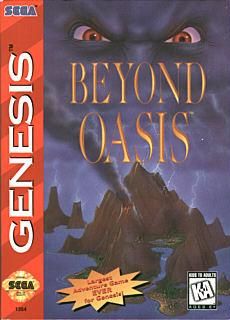
Beyond Oasis Review

I remember fondly (sort of) the days of the 16-bit console wars and the arguments that would ensue over whether the Super Nintendo or the Sega Genesis was the better console and which had the better games. Often these "discussions" came down to software comparisons, some obligatory such as Super Mario World vs. Sonic The Hedgehog, and some not so, like Chrono Trigger vs. Phantasy Star IV. Whenever The Legend of Zelda a Link to the Past was mentioned though, there was one game that was almost always used as a counter.

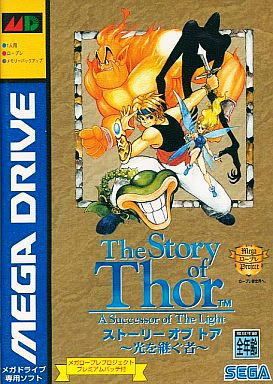
Enter Beyond Oasis, otherwise known as The Story of Thor in other territories, and often regarded as a Zelda clone. It's a shame to me that this title lives in Zelda's shadow to many players of the 16-bit era. Yes, both titles sport a top down perspective, active combat, puzzle solving, and dungeon exploration. However, in my opinion, Beyond Oasis has enough differences for it to stand alone as its own unique title. 

That being said, I'll try my best not to make comparisons between the two. Both have great things going for them and in the end award very different experiences for the player. Instead, I would encourage you to read what I have to say and then give them both a try to decide for yourself if you so wish.

The story begins with the main character, prince Ali, doing a bit of treasure hunting, which you soon discover is one of his favorite hobbies. In a particular chest, he discovers a mysterious golden armlet and decides to try it on. Naturally the armlet becomes stuck and a mysterious spirit appears to warn you of a great evil descending upon the land. Suddenly a violent earthquake erupts and you narrowly escape the island cave before it's swallowed up by the ocean. After returning to town, a sudden monster attack sets the prophecy in motion. You soon find out from the King that it is your destiny to return the golden armlet to its full power and rid the world of this unknown evil. And so the adventure begins...


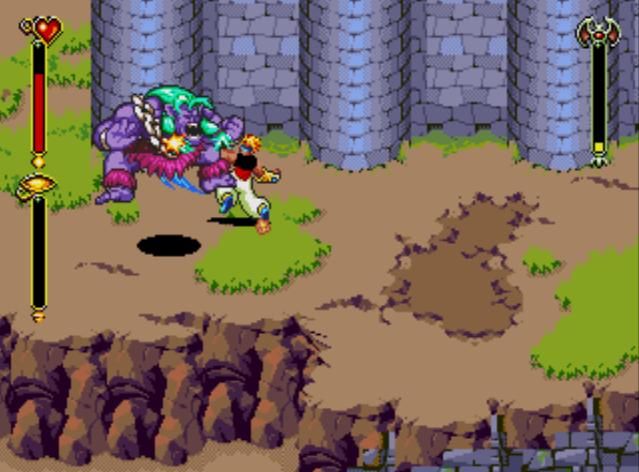
As stated above, combat is always live, meaning enemies will attack as soon as they notice you. Fortunately for you, Ali has a generous variety of attacks and special moves to deal with any mob you cross paths with.

The dagger, which is the default weapon, is also the most versatile. It cannot be broken or set down and has the longest list of special moves available. Tapping B makes you stab, but press it rapidly enough will make Ali kick rapidly. Holding B for a brief moment and releasing causes a powerful horizontal swipe that knocks enemies down. If you get surrounded, a quick 360 motion on the d-pad plus B gives you a quick spin slash that blows enemies back and grounds them. If you pressing B while running produces an even stronger swipe that launches enemies in a disorienting spin. The most powerful move, and my personal favorite, is the back flip, which is executed by pressing forward, back, forward and B. It hits multiple times and chunks some major damage.

On top of that, you can find extra weapons such as broadswords, crossbows and bombs, some of which have special extra effects. The downside to the alternate weapons is that they break and must be discarded after so many attacks. That is unless you're clever enough to find the rarest versions for your arsenal.

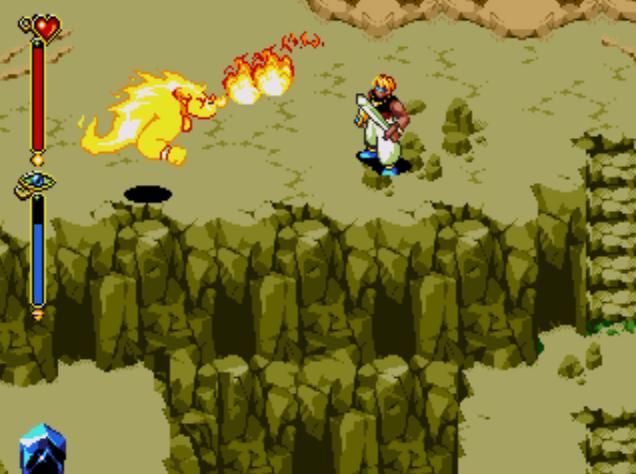
Joining Ali in battle are four elemental spirits you meet one by one by completing the game's dungeons. You can summon them into battle by shooting a ball of light from the golden armlet at their represented element. For example, hitting a flaming torch on a cave wall will summon the fire spirit, Efreet. Once the spirit is present, the A button allows you to issue commands. Pressing, tapping, or holding A will make the spirit unleash one of their special moves. Watch your magic meter!

Not only are they capable sidekicks in battle, but they also help you traverse the world around you and navigate dungeons. Unlike collecting equipment like in Zelda, the spirits act as your extra tools. Such as using Dytto, the water spirit, to extinguish a wall of flames, or Efreet to light torches. It's this spirit mechanic that gives the game a unique depth that's rare to the genre.

I was very impressed with the level of detail that went into summoning the spirits themselves. Most of the time there are obvious elemental sources to allow you to summon, but you can get creative as well. For example, you can toss a bomb and if you shoot a ball of light timed so it touches the flames of the explosion, you can summon Efreet. Every source of water makes it possible to summon Dytto, right down to the tiny droplets of water falling from the ceiling of a cave if timed correctly. The shadow spirit, Shade, can be summoned from the reflective surface of the great knight's armor. It really encourages you to explore the environment in detail. The only spirit that didn't seem to get this treatment is Bow, the plant/earth elemental. While plant life is in abundance in Oasis, you can only summon him from certain ones. I guess it would be too easy to summon him otherwise.

Overall the game is more focused on action than puzzle solving. While the dungeons are littered with puzzles, there's nothing that will leave you head scratching like in Zelda. Some of the more difficult segments of the game are actually platforming related, particularly later in the game when you're tasked with navigating small moving platforms. There's even a boss that takes place over a giant pit with a handful of flying platforms as your only means of staying alive. Thankfully falling down a pit doesn't kill you instantly but rather only takes a bit of damage. Regardless, the frustration is still there. The best method for surviving such trials is to be patient, time your jumps carefully and watch Ali's shadow as you fall.

Oasis is an open world and there's plenty to explore though it does become a bit linear once you sail to the northern region of the island. Thankfully once you meet Shade and gain access to the warp network (essentially fast travel) things open back up again, giving you the opportunity to visit past locals with your new spirits in tow.

Visually, Beyond Oasis is one of the nicest looking games on the Genesis. The backgrounds are colorful and full of detail and every sprite in the game is beautifully animated. The music was composed by famous Japanese composure Yuzo Koshiro and captures the feeling of grand adventure perfectly. The sound effects feel as though they were ripped right out of Streets of Rage, though they are slightly different. Ali actually sounds just like Axel.

If you're hungry for an action adventure, I highly recommend you give Beyond Oasis a try. Even if you decide Beyond Oasis is mere Zelda clone, I can safely guarantee the adventurer in you will have a blast seeing it through to the end.


Pros:

-Combat is fun and addictive.
-Beautiful graphics and animation.
-Sound track is grand and memorable.
-The spirit/summon system is unique and fun to utilize during gameplay.

Cons:

-Has some annoying platforming segments that can be difficult to traverse in this type of prospective.
-The journey becomes linear for a noticeable portion of the story.

Note:  The version I reviewed was my original Sega Genesis cartridge, but you can also find Beyond Oasis available on the Nintendo Wii e-shop and on the Sonic's Ultimate Genesis Collection disk for Playstation 3 and Xbox 360.  I have all of these versions and find them all to be pretty much perfect ports of the original.

Sunday, January 19, 2014

Bio Hazard Battle Review

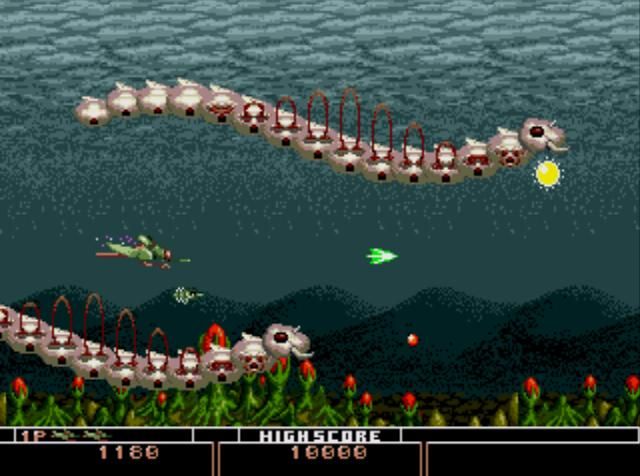
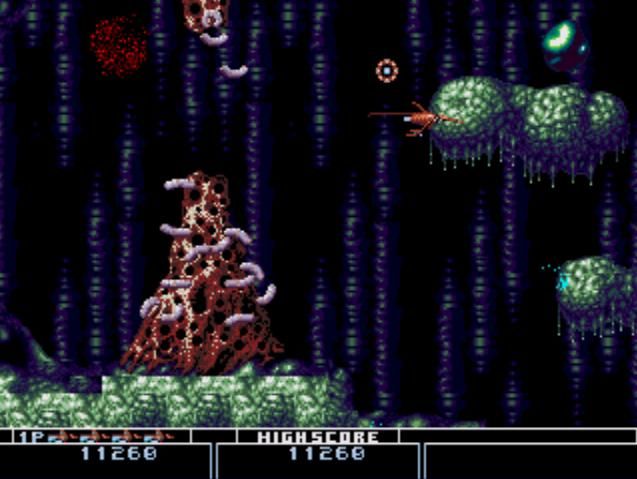
Lately I've found myself addicted to shmups, usually of the horizontal scrolling space craft variety, but there's one in particular from my childhood that I keep returning to time and time again. There's certainly a feeling of nostalgia that lends itself to this title for me, but it has a lot going for it otherwise, particularly the sci fi, almost horror atmosphere this game creates. So tonight I want to share a little more about why I love Bio Hazard Battle for the Sega Genesis.


Bio Hazard Battle takes place on the fictional world of Avaron which has been overrun by horrendously mutated flora and fauna as a result of a planet wide "bio-war" that happened some time ago. It is your job to pilot one of four available "bio-ships" down to the surface to search for a suitable place for mankind to recolonize.


The game begins with you being dropped through the upper atmosphere from the colony ship. It becomes rapidly apparent that your stay on Avaron will not be a hospitable one. It's clear that the planet hasn't been able to repair itself from the aftermath of the bio-war as I'm pretty sure giant flying squid, centipedes and bees in the upper atmosphere couldn't be normal. The only option left then is to begin hunting the source of the mutations.

That's the story in a nutshell, which is delivered entirely by the game's manual and brief synopsis on the back of the box. There are no narratives or cutscenes during the game itself, so if you have a loose cartridge or your download didn't include a manual then you won't have much to go on. If you've played a lot of shmups though, you'll know that the story usually takes a back seat to the action anyway.

Gameplay wise, BHB ends up being exactly what you'd expect in any shmup. In the beginning you choose from a selection of 4 different bio-ships. Unfortunately there's no way of telling the differences between each ship from the selection screen, you'll have to rely on trial and error to decide which one you like best. After experimenting you'll find that the ships move at different speeds and have different sub weapons based on the colored seeds you collect. The differences aren't dramatic enough for one ship to be better than another, but so you can find the movement speed and sub weapon load out that best suits your play style.


If you're a veteran to the genre then BHB probably won't surprise you very much. The game doesn't really throw anything at you that you haven't already dealt with in other shooters. I feel like the game's favorite gimmicks are brief spurts of bullet hell while much larger enemies try to crowd the screen from either side.

Success comes much easier the better you are at controlling the external pod that fires your sub weapon, which rotates the ship opposite of your d-pad input. So in other words, if you move the ship backwards, it will swing to the front. It can be awkward at first but after a few plays you should get the hang of it. The pod is indestructible and absorbs enemy fire, so learning to use it as a shield becomes crucial in later stages. Each ship has its own charge blast, which is just about guaranteed to destroy any of the larger beasts that wander into the screen. The down side is that it takes roughly the same amount of time to charge the blast as it does a mega buster in a Mega Man game, but during this time neither your ship or your pod can fire. Even though it only takes a little over a second to charge you must be aware of your surroundings and enemy fire before doing so, which can make it a bit of a gamble towards the end of the game.

If any of that doesn't sound like your thing, I must at least recommend that you play the game for the music. BHB has some of the most amazing and chilling tracks in the Genesis library. They all do well to drive home the intended sci-fi horror atmosphere of a planet infested with grotesque flying worms and other entomophobic nightmare fuel. I'd like to note that the boss music is one of my all time favorite boss themes.

The sound effects are nicely done too, especially from defeating the larger enemies. They have this nice mixture of explosion-splatter that makes it really satisfying to take them down.


The graphics themselves are sort of hit and miss. While the bio-ships and enemies are beautifully drawn and nicely animated, the backgrounds can be a bit bland. Some do stand out though, such as the jungle and under-sea missions. The bosses are nice to look at but don't offer any sort of challenge. Other than the nice sprite work they can come off a bit disappointing in practice.

If you're a hard core shmup enthusiast, this game may be a bit of a mediocre experience for you. However, I do feel like the difficulty is at a comfortable enough level for me to recommend it to someone who may just be getting into the genre. As I said above, I do recommend that anyone give the game a try to at least experience the music and the atmosphere it creates. I feel like that's what really pulls me back to this game time and time again.

Pros:

-Awesome music and sound effects.
-Controls are precise and live up to the standards of any great shmup.
-2 player simultaneous co-op.
-Great animation and creature art.

Cons:

-Might be considered too easy or mediocre if you're a shmup enthusiast.
-No in game ship statistics or listings of sub weapons.
-No in game narrative. The ending may be a bit of a let down too.
-Backgrounds are a little bland.

Note: The version I reviewed was my original Sega Genesis cartridge but the game is available for download on the Nintendo e-shop and on the Steam network. I have not played those versions, but I've heard from other sources that they are pretty much perfect ports.

Review Policy

As I'm about to publish my first game review of 2014, I thought it might be important to explain my policy on game reviews going forward.

It's a bit of a lengthy read, but if you frequent here it might give you more trust in the reviews I do.

To read it, click the button in the navigation above, or simply click here.

Wednesday, October 9, 2013

It's not a bad game because you're bad at it

One of my pet peeves about game reviews are the ones in which the game receives a poor final judgement that's reflective not of the quality of the game itself, but of the players inability to play the game effectively. I'm not saying those reviewers (I'm going to avoid specific examples and names unless it needs to be discussed further) are bad at gaming in general, but we all have our strengths and weaknesses when it comes to this hobby. That being said, sometimes there are some games that certain reviewers just shouldn't touch unless a disclaimer is given at the beginning.

To illustrate my point, I'll use myself and the Tekken series as an example as that's one particular series that comes to mind that I often have difficulties with.

Where my fighting game experience is concerned, I grew up playing 2D fighters pretty much exclusively. As such my taste in fighting games continues to lean more towards the 2D entries of the genre. Knowing that, you probably assumed correctly that I don't particularly enjoy the Tekken series. Some of the reasons why are that I have difficulty maintaining proper spacing between myself and my opponent on a 3D plane, I have trouble sometimes getting the characters to move how I want, and in the heat of combat sometimes the combo system gets lost on me. When I play Tekken it's usually the single player experience as taking on a live opponent can be frustrating for me.

Does that make any of the Tekken games bad? Typically the Tekken series delivers top notch graphics and the music is always amazing in my opinion. It's usually the gameplay itself that I have trouble with. Tekken has a tremendous amount of followers that spend hours upon hours mastering the game competitively, where as the majority of my time has been more of a casual single player experience. Do I really have the right to condemn the game as a bad one? Can I really make statements about the combo system being bad because I personally had trouble with it?

If I were to write a review on a Tekken game, my opening statement would clearly state that I played the game from a casual user standpoint. That should be the standard with any game or genre you're not comfortable with.

I think the problem with a lot of reviewers, especially the folks that write for major publications, is that they don't want to admit that they can't be a master at every game they play. Which shouldn't be something to be ashamed about, but I do understand that landing a position as a professional reviewer probably has certain expectations of skill to uphold.

That's really all I can say on the subject, is just to be honest about what you really thought about the game itself and not let your frustrations make for a sour review. It's certainly okay to talk about how difficult a game is, just remember that what is difficult for you may be easier for others and vice versa.

I just had a thought from writing this. I should post my own standards for review so people will have a better feel of what kind of player I am. That way they can decide how much stock to put into my reviews.  Something to think about anyway.

Tuesday, September 24, 2013

DuckTales Remastered Thoughts/Review

Blathering blatherskite! A high definition remake of one of my favorite childhood video games!

When I first heard that an HD remake of Ducktales for nes was in the works I could hardly believe it. But then again, ask any of us 30 something video game enthusiasts to name some of their 8-bit favorites and there's a high probability Ducktales will be mentioned. In a way, I'm surprised the game hasn't been remade before now, or at least included on some sort of collection.

That being said, let's take a dive in the money bin and talk about what's so great about this game, as well as some things that may not have stood the test of time.

Ducktales is your standard 2D platformer of the time, constructed in the Megaman engine by a lot of the same developers that worked on that series. The game even plays out a lot like a Megaman game in that you never have to follow a predetermined order of levels. At the start the player can choose from five destinations and tackle them in any order they choose. The remastered version takes a more Megaman X approach and throws you into an introductory stage to help you become acclimated to Scrooge's abilities and the nature of obstacles you'll encounter throughout the game, including a nice easy boss to show you how those fights play out.

What I particularly loved about Ducktales as a kid was how it captured the atmosphere of adventure and exploring. If you're running for speed you'll eventually learn the fastest way through each of the levels, but if you really want to rake in the treasure you're going to want to explore the multiple branching paths each stage has to offer. Unlike the original version, pausing the game reveals a map, including icons of interest to show you exactly where you want to go. While it's helpful if you get lost, I feel like it detracts from the size these levels held in the original game. Not a whole lot has changed in terms of the layouts themselves. All of the secret areas of old are in tact so you can experience a warm nostalgic pat on the back for remembering them as well as enough new changes sprinkled about to keep the experience fresh.

Scrooge himself handles nearly identically as in the original version. Overall the controls feel tight and Scrooge does what you intend for him to, well except for falling down a pit or into some spikes, but at least you'll know it was your own miss-timing to blame. Walking and jumping will feel exactly as you remember it, as well as the famous pogo cane made famous by the original game. For beginners, they simplified the pogo technique itself to allow you to focus more on what you're trying to achieve with it while you're learning. Now all you have to do to pogo is simply press and hold the square/X button. For veterans you can turn this off and return to the down+button input if you so wish.


The most notable difference you'll see between Remastered and the original game is of course the beautifully redrawn sprites and 3D backdrops. The sprites themselves look like they leaped right out of the cartoon. They're animated so well that it's still entertaining to take some damage just to see the extended animations play out, like when you're bitten by the giant venus fly traps in the Amazon, or when you smack your cane against a wall just to see the vibrations ring through Scrooge's body. The backgrounds themselves are 3D rendered, but still work on a 2D plane. Thanks to modern technology, the backgrounds now appear to have way more depth to them, which helps these characters appear as much more than cartoons moving through a paper world.

Fans of the original title will remember, or rather not remember, the story which was practically non existent other than the obvious quest for more money, a mainstay of the show itself. Remastered makes an effort to actually explain why you're doing what you're doing in each level. These cutscenes take place in game and are voiced by the original voice actors from the cartoon. Hats off to this crew, because they sound amazing, as if the show never ended. These scenes usually play out as lengthy banter between Scrooge and one of the other characters that accompanied you on your current adventure. They're entertaining the first go through, but really hurt the game's pacing after that. I'll cite the Amazon as one of the worst examples as you'll be stopped over 10 times to either hear Scrooge make a crack about the coins you're collecting or to remind Launch Pad of how terrible a pilot he is (though most of the time he proves it on his own). Fortunately you can pause and skip each of these mini cut-scenes at any time. It can be bothersome but at least the option is there. It would be nice if you could opt to turn them off all together.

The game can be unforgiving when it comes to dying.  There are no check points along the way and your lives are limited, which means when they run out it's back to Duckburg with you and all your progress in that level is gone. Depending on your skill level or when exactly you started gaming this could make for a grueling experience. You could argue that this kind of punishment for losing is archaic, but honestly that's just the way things were back then. To me a game's quality isn't reflective on how difficult it is. If I'm not good at a game, that doesn't mean it's a bad game, it means I either need to try harder to learn the game or move on to the next one. To me the lack of check points and unlimited lives is not a negative thing, but nor is it positive. I just wanted to mention that it's a factor a lot of players are having issues with.

In addition to the main game there is a vault load of development sketches, paintings, development art, music files, and even art from the original show.  In the original game, your money count acted as little more than your score, but this time around you can actually spend the dough you find to unlock the extras in the gallery. I feel like the prices are fair enough that you can unlock a ton of stuff from a regular play through without it feeling like you're grinding to unlock stuff.

In the end, if you really enjoy 2D platformers Ducktales I have no doubt you'll love Ducktales. It just seems to get all the fundamental elements right. But if you have difficulty with 2D gameplay or just don't care for the way games were designed in the late 80's/Early 90's then you'll probably want to pass this one up, because this is one throwback that clings very hard to its roots.

Pros:

-A faithful recreation of the classic game with enough extras and changes to make it a fresh experience.
-Solid controls with some customization available.
-New graphics and music are top notch. Get ready for the Moon theme to be stuck in your head again.
-Lots of unlockable extras increases replay value.
-Voice acting is fantastic. Feels like a faithful extension of the show.

Cons:

-Cutscenes are numerous and cause frequent stops in the action.
-(Debatable) Limited number of lives, no save states, and lack of check points could make the game a bit too difficult for younger players.

Thursday, June 13, 2013

Sonic Classic Collection Nintendo DS Review

Have you ever wished you could play the Sonic the Hedgehog Sega Genesis/Mega Drive titles on the go, whenever you wanted? Sonic 1 Remastered was recently announced for the 3DS eshop so I wanted to write a quick review of the classic handheld offering for those who may not have a 3DS at this point, or maybe for those who don't want to wait on the other genesis titles to be released. Though likely, there's no guarantee at this point that they'll do a remastered version of the other titles.

Sonic Classic Collection for Nintendo DS, as the title suggests, is a collection of the main entries of the 16-bit Sonic the Hedgehog series. The collection includes Sonic 1, Sonic 2, Sonic 3, Sonic & Knuckles, and also features the "lock on" technology of the Sonic & Knuckles cartridge, meaning you can play as Knuckles in Sonic 2 and the complete Sonic 3 & Knuckles experience. It would have been nice to have the other Sonic genesis titles such as Sonic Spinball or 3D Blast but if you ask me it has the essentials covered.

The games feel nearly identical to their original 16-bit versions save for a few minor things that I believe to be hardware related.  For example, there appears to be a slight amount of slow down in the Labyrinth zone of Sonic 1 in the submerged underwater areas due to the "wavy" effect on the background. In Sonic 3 & Knuckles there appear to be some layering issues with some of the sprites on a few occasions.  For example near the end of the game in the emerald chamber when Knuckles grabs onto the master emerald Dr. Robotnik just snatched he goes behind it rather than hanging on to the front of it.

There have been no touch ups to the graphics themselves, which is great for the purists out there but again there are some hickups caused by the DS hardware itself. The DS does not support the original aspect ratio of the Genesis, so the overall image of the game appears to be slightly distorted. It's not terribly noticeable, it just appears like there's no antialiasing going on and thus more jaggies appear. The only instance I can think of where this seems to affect the in game graphics themselves are in the lampost magnetic sphere bonus games of Sonic 3 & Knuckles where the walls appear to have black diamonds or holes due to the adjusted resolution. Note that I have played the game on the original DS model, DSi and on a 3DS and this issue persists.

There are also some slight differences in sounds due to the hardware emulation.  Each game seems to have a few sound effects that sound a little off from their original 16-bit versions. Thankfully all of the music in the game sounds pretty much exactly the way it did on the Genesis, with the exception of Launch Base zone in Sonic 3. It's not tremendously different, it just sounds like the pitch is up a bit.

Aside from the games themselves there are very little extras included, which is disappointing compared to the console Sonic collections that have released over the years. Where the console versions include rare artwork, prototype designs and even creator interview movies, in this version all we get are some lack luster clip art quality Sonic images from various games.

The menus themselves are pretty dull too. Nothing animated or even colorful, just the image of the games you have to select from. While this isn't that big of a deal (I mean I bought it to play the games, not surf menus) it does make the project seem a bit lazy.

My biggest gripe with the collection are two important missing features from Sonic 2 and 3. In Sonic 2, the options menu is missing and instead you toggle through your character selection on the title screen. This is significant because without the sound test menu you are unable to enter the level select or any other codes for Sonic 2. The inability to jump to your favorite stage means you'll always be left playing Sonic 2 from the beginning or from where ever your last save state left off.  Sonic 2 had some really neat codes too, such as the debug menu. The only way to level select in Sonic 2 now is if you're playing as Knuckles because his code must be input on the title screen. Sonic 3 is missing access to the multiplayer levels. It's clear that they had no intention of multiplayer support for this game, but in the original Sonic 3 you could at least practice on these levels and try to best your own times.

Aside from the above mentioned hickups the speed is there in full force and you'll find that these titles play admirably close to the original cartridges. Until we see some sort of re-releases of the remaining games, this collection is the best way to be able to play the classic Sonic games on the go.

Pros:

- Nearly perfect ports of Sonic's main adventures, fully accessible out of the box.
- Save state feature lets you pick up your game where you left off (It does not save your exact position but will start you at the beginning of the last level you saved in. The save feature for Sonic 3 and Sonic 3 & Knuckles functions exactly the same as it did on the Genesis)
- Level select codes and other "cheats" are still in tact and input the same way as on the Genesis, except for Sonic 2.

Cons:

- Some minor flaws in the aspect ratio and the occasional sound effect.
- Multiplayer levels missing from Sonic 3.
- Options menu/sound test missing from Sonic 2.
- Menus and extras are bland and add nothing to the overall package.